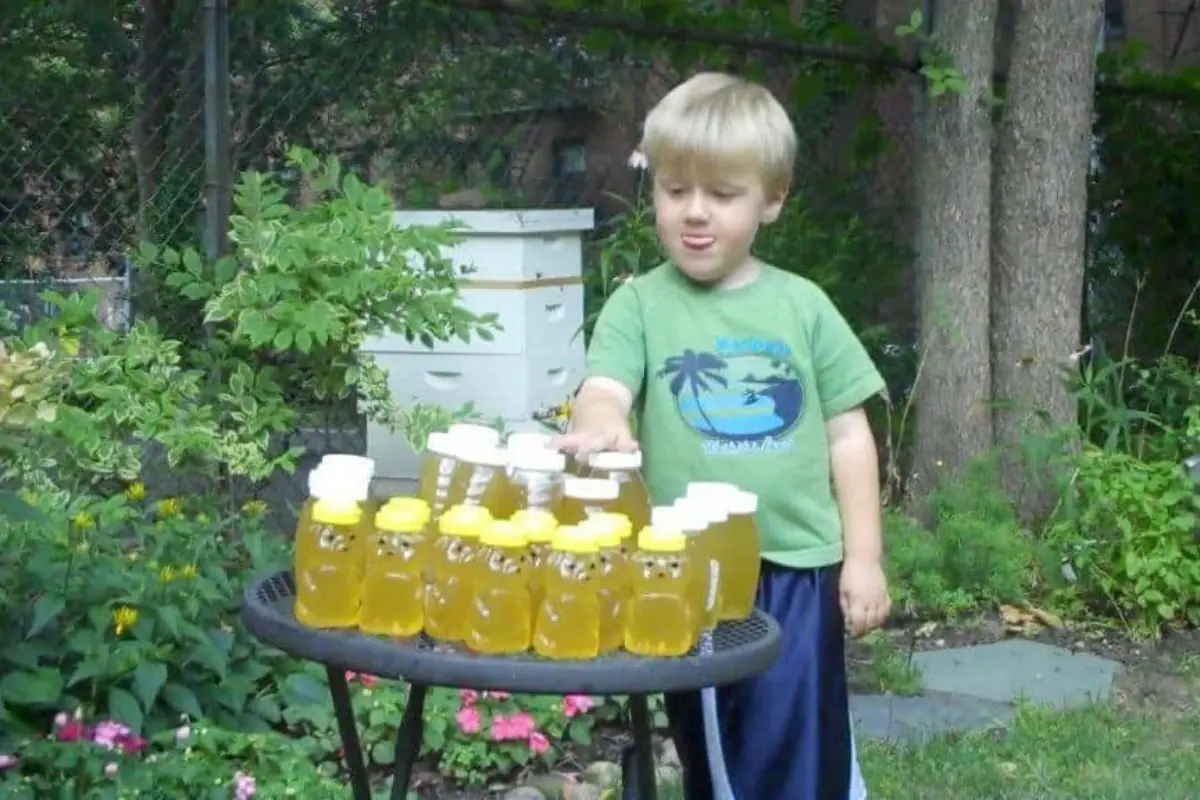
Summer, 2010. Our very first honey harvest. Johnny was five years old.
We had two little boys, and Winnie the Pooh and the Honey Tree was a household favorite.
Johnny and his twin brother, Raymond, had spent months wondering what was happening inside those white boxes in the backyard. (You can actually spot one of the hives in the background of the photo. Notice there are no windows in a beehive!)
In the picture, Johnny is trying to count jars of honey while licking his lips and saying, “Yummy!” It’s one of my favorite photos because it captures exactly what that first harvest felt like—equal parts wonder, excitement, and impatience.
Can you see it like I can?
It Started With Curiosity
I didn’t become a beekeeper because I planned to start a honey business.
I started because I was curious.
I also wanted my boys to understand where food comes from—that it doesn’t simply appear on a grocery store shelf. I wanted them to see how plants grow, how pollination works, and how connected everything in nature really is.
The bees became some of our best teachers.
We watched them work our vegetable garden. A neighbor, two backyards away in Sunnyside Gardens, told us he’d noticed our bees visiting his apricot tree. That year, for the first time, his tree was loaded with fruit.
We watched one hive grow from two boxes to five.
Little by little, the boys began to understand that every jar of honey begins with the work of the bees.
The Bees
It all begins here
The honey story begins with thousands of small journeys. Bees leave the hive again and again, searching for flowers, gathering tiny drops of nectar, and carrying them home. Home is the hive, where thousands of bees work together to transform that nectar into honey, filling the comb one cell at a time.
Nothing about honey can be rushed. It is made through patience, teamwork, and countless small acts repeated by the bees day after day. Every drop is a reminder that some of the sweetest things in nature are built a little at a time.
The Beekeeper
The craft behind every jar.
I took my first beekeeping class from a true craftsman, Wally Blohm. He taught me the basics—how to light a smoker, build a hive, and find the queen—but those were only the first lessons. More importantly, he taught me to slow down, to watch, and to listen to what the bees were telling me.
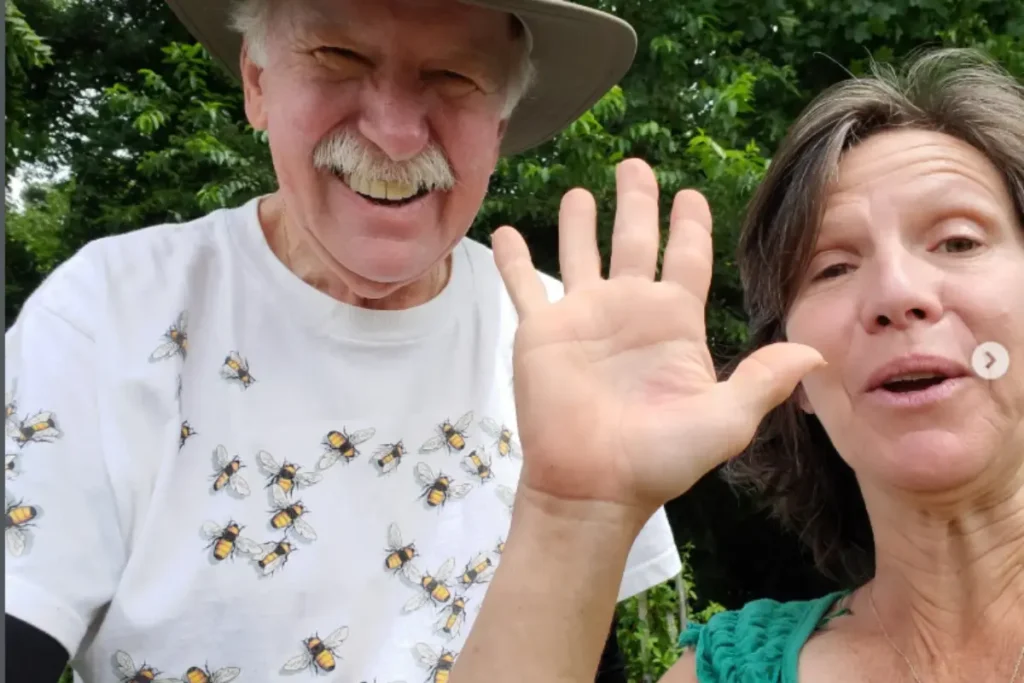
Beekeeping takes patience. You can’t rush the bees, and you can’t force a hive to thrive. All you can do is care for it—checking its health, reading the seasons, and knowing when to step in and when to step back. A good beekeeper understands that the work is never really about making honey. It’s about tending a living community. The honey is simply the gift that follows.
The Harvest
The gift from nature
Before I became a beekeeper, I thought honey was simply…honey. I had no idea it could be pale as straw, deep gold, or almost the color of mahogany. Each harvest tells the story of the flowers the bees found—clover and wildflowers, black locust, basswood, goldenrod, or the blossoms of fruit trees—and the season they lived through.
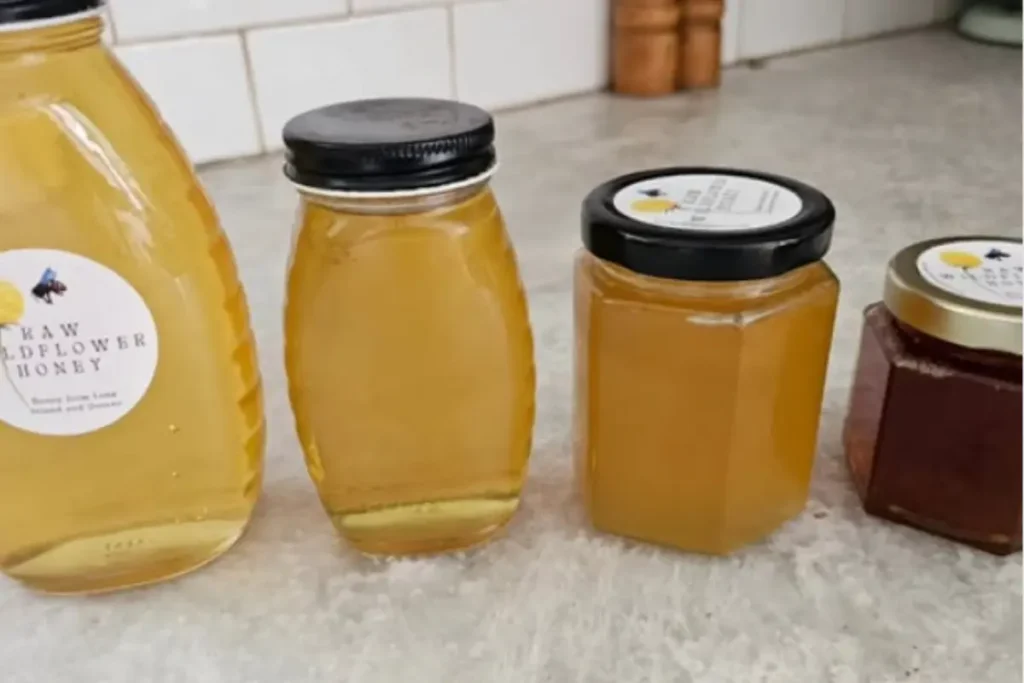
No two harvests are exactly alike. A rainy spring, a field of blooming clover, or a stand of basswood trees can all leave their mark on a jar of honey. Every color, aroma, and flavor is shaped by the flowers, the weather, and the landscape, making each harvest a small work of art.
RESPECT THE HONEY
When you understand the work of the bees, the craft of the beekeeper, and the influence of the seasons, it’s hard to look at a jar of honey the same way.
That’s what we mean when we say: Respect the Honey.
Waste Nothing
Customers often ask us, “Why don’t you sell your honey in those cute little honey bears?” They are cute. And yes, it’s fun to squeeze their little tummies.
But…the waste. It’s unbear-able. Literally.
The nose.
The paws.
The belly.
They are almost impossible to empty completely.
No…no plastic squeeze bears for us.
Glass jars aren’t cute. They are more expensive and more fragile than plastic, but they don’t absorb flavors or odors. Raw honey in a glass jar tastes exactly as the bees made it.
The Glass Jar
Choosing glass isn’t just about protecting the honey.
It’s also about reducing waste.
Unlike disposable plastic, glass can be reused again and again. That’s why we encourage customers to bring their empty Backyard Bees honey jars back to the farmers market.
We take $1.00 off your next jar of honey as our way of saying thank you for bee-ing green with us.
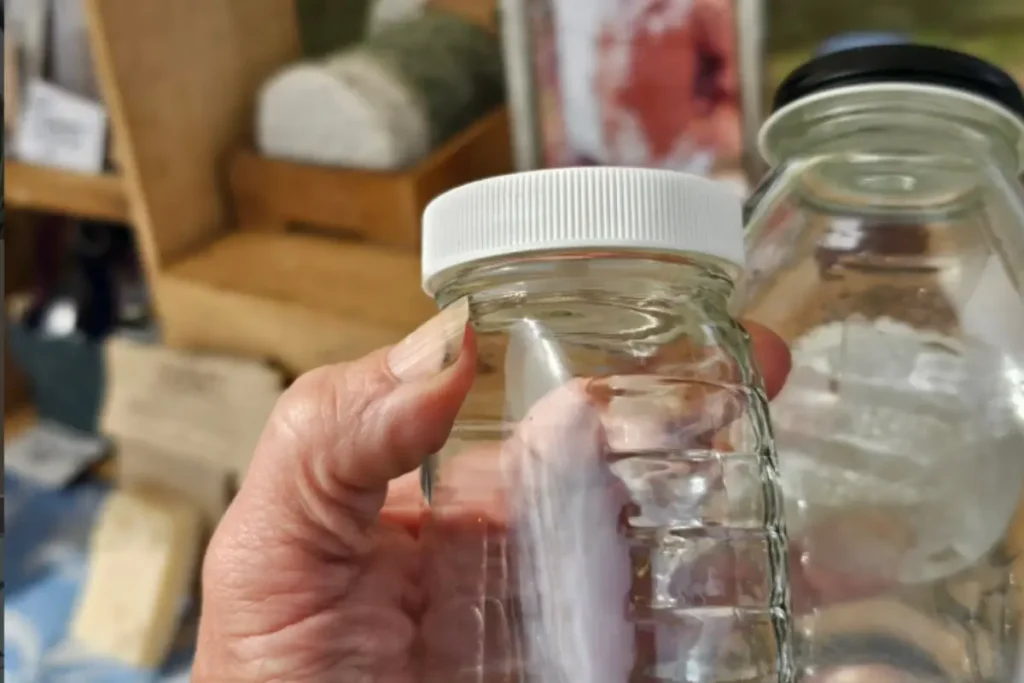
Each returned jar is carefully cleaned, sanitized, and reused, giving it another life before it ever needs to be recycled.
Respect Every Drop
When you know what it takes to make honey, it’s hard to waste even a little.
So we don’t.
Here are a few of our favorite ways to enjoy every last drop:
- Use a honey dipper. The grooves make it easy to collect honey from the sides and bottom of the jar.
- Try a fork. It sounds a little unconventional, but it makes a surprisingly good drizzle tool. Dip it into the honey and let it slowly run off the tines over toast, yogurt, oatmeal, fruit, or even into a cup of tea.
- Make honey simple syrup. When only a little honey is left clinging to the sides, don’t rinse it away. Add equal parts warm water, screw the lid back on, and shake until the honey dissolves. You’ll have a delicious honey syrup for iced tea, lemonade, coffee, sparkling water, or cocktails—and you’ll have enjoyed every last bit.
More Than Just a Jar
Fifteen years ago, I thought beekeeping would teach my boys where honey comes from.
Instead, it taught all of us something else.
It taught us to notice the work behind simple things.
The work of the bees.
The work of the beekeeper.
The work of the seasons.
Every jar carries that story.
Once you understand what it takes to make honey, it’s hard to see it as just another sweetener on a shelf.
You begin to see it for what it really is:
a gift worth respecting.
Continue Exploring
If you enjoyed this story, you might also like:
The Honey Guide
Everything you need to know about storing, using, and enjoying local honey.
→ Read the Honey Guide
🐝 Shop Our Raw Honey
Explore this season’s harvests and discover how the flowers and seasons shape every jar.
→ Shop Local Raw Honey
More About Respect
The story continues with:
- Respect the Bees (Coming Soon)
- Respect the Flowers (Coming Soon)
- Respect the Beeswax (Coming Soon)
- Respect the Seasons (Coming Soon)