It was devastating. It was fascinating. And a little treacherous.
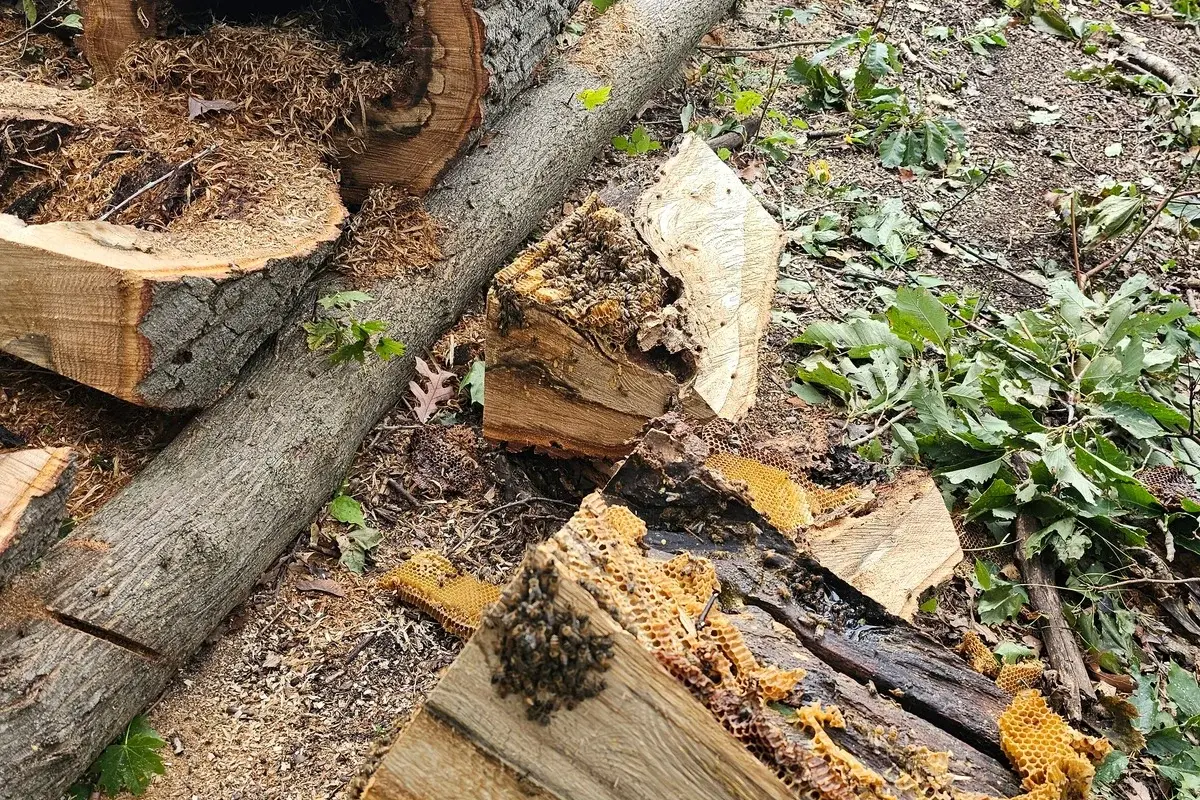
I was looking at the remnants of a honey bee colony, scattered among the debris and enormous slices of a fallen tree. It was hard to know where to begin. This bee rescue was anything but straightforward.
There were bees everywhere, but not in the way you might expect. No great, reassuring cluster. No obvious center of activity. Just pockets of bees clinging to pieces of wood and comb, trying to make sense of a world that had quite literally been pulled out from under them.
I didn’t know if I could save them. But I knew I had to try.
How It Came to Bee…
I was in the middle of my Saturday morning farmers market at Eisenhower Park. It was windy and overcast, and the temperature had dipped into the 50s for the first time in a while. I hadn’t expected a crowd, but business was steady, and I hadn’t really noticed that my phone had been ringing.
During a lull, I finally looked at it.
A friend had called five times.
Hmmm.
When I got in touch with him, the details were a little sketchy. There was a “swarm” of bees behind “his neighbor’s house.” They were “definitely honey bees,” and they had been discovered after someone cut down an old tree.
Could I help? Of course, I said I’d take a look.
The Truth
As it turned out, the neighbor wasn’t actually a next-door neighbor. It was his next-door neighbor’s SISTER who had cut down the tree. On Friday afternoon.
And the bees weren’t where I thought they were, either.
They were another 20 minutes away.
Then there was the long driveway. And the building. And the steep, untamed hillside behind it, covered in saplings and thorny things. Getting to the site meant navigating the whole obstacle course before I could even begin to assess the situation.
Still, the facts were close enough.
The bees had been displaced, their home destroyed, and they needed help. The weather was turning cold, and time was not on their side.
I gathered what information I could and headed out to see for myself.
Assessing the Damage
No one likes to waste their time.
Even if I could collect these bees and give them a home, what were the chances I could actually save them?
Realistically, I had to consider more than the bees right in front of me. I had to think about the time of year, the resources they’d need to survive the winter, and the fact that the temperatures were dropping. Honey bees can tolerate cooler weather under the right circumstances, but once temperatures dip much below 50 degrees, their ability to fly and forage becomes increasingly limited.
October isn’t the prime time for starting over.
I couldn’t even reconstruct the scene. I couldn’t find the obvious spot where the tree had been cut down from, and I had no idea how long the colony had been exposed.
What I could see was troubling.
The bees weren’t gathered into one large cluster, which might have suggested they were protecting their queen. Instead, there were at least three very large clusters, plus smaller groups tucked beneath and behind wedges of the tree.
I didn’t see many bees flying, either. Usually, there’s a hum of activity, a sort of buzzing communication as bees orient themselves and work to stay connected to their queen. Here, I couldn’t find any clear indication of where to begin.
Then I spotted a small group of nurse bees trying to keep their brood warm.
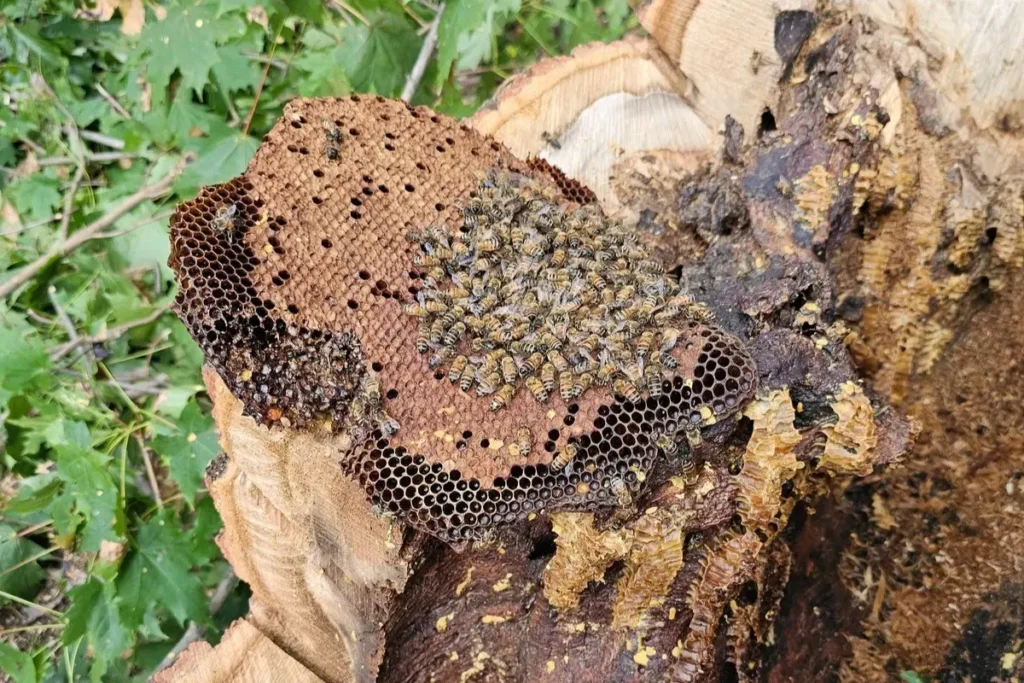
It was heartbreaking. They were doing their best, but they covered only about a quarter of the brood. Other sections of comb had been completely abandoned. The nurse bees were trying to do what nurse bees do: protect the next generation. But there simply weren’t enough of them in the right place to do it.
Curiously, there didn’t seem to be any honey in the debris. At this time of year, a healthy colony of this size should have a substantial store to get them through the winter months. Instead, there was no obvious stickiness, no honey-soaked debris, and no lingering robber bees or yellow jackets taking advantage of an easy meal. My only theory was that the tree cutters had found the honey and decided to grab it and run.
But I also began to wonder whether something else had been going on with this colony before the tree came down. Were they sick? Had they been struggling for some time? I had no answers, but I was adding questions to my list.
I was looking at a colony that had lost its home, its honey stores, and possibly its queen. The brood was exposed, the weather was turning, and I had no idea whether the bees were healthy or why the colony had been left in such disarray.
I don’t like to waste my time, either. Things weren’t looking too good for these bees. But maybe one of my flaws is that I’m eternally optimistic.
This wasn’t going to be a quick and easy swarm catch. I couldn’t just shake a cluster into a box and call it a day.
But I could NOT abandon these bees to the elements. Something is always better than nothing.
The Bee Rescue Plan of Attack
I started back down the slope, around the building, and down the driveway to my car, thinking through the possibilities as I went. And continued thinking as I drove to my closest bee yard to gather supplies.
Two hive bodies. A bottom board. Frames. A roof.
What else would I need?
Where should I start? What if I couldn’t find the queen? What if the colony was sick? Was that why there was no honey? How was I going to get all these scattered bees into one place, especially with the temperature dropping?
There was a lot to think about.
By the time I returned, I had a plan. Or at least the beginnings of one.
I lugged everything back up the hill, suited up, and got my smoker going. I was ready to work through the clusters one by one and see if I could locate the queen.
My first brilliant idea was to take the existing frames of brood and comb and attach them to wooden frames so I could place them inside the bees’ new home.
It seemed reasonable enough.
Except the bees had been exposed longer than I’d realized. Some of the comb was already brittle instead of flexible, making it much harder to handle without damaging it.
Then, just as I was getting into the work, I noticed something else.
Hive beetles.
Lots of them.
They were dropping into the hive along with the bees.
If you’re a beekeeper, you know that feeling. What was the point of rescuing these bees and giving them a nice new home if I was also transporting a bunch of unwanted pests into it?
Hive beetles are a nuisance under ordinary circumstances. A colony already struggling to survive is particularly vulnerable to additional stress.
I was not thrilled.
But there was nothing to be done about that at the moment. I had a rescue to finish, and the beetles were going to have to wait their turn.
Paul Bunyan, Superhero
My next move seemed simple. It was not. In retrospect, it’s actually pretty comical.
I lifted a wedge of the tree that had a significant cluster of bees clinging to it. My plan was to set it on top of the first hive body and let the bees make their way down into their new home.
I had a little bee brush and began gently sweeping the bees toward the box. And then I saw the little black hive beetles pouring in with them.
Nope. Not what I wanted.
So I picked up the wedge again.
Let me tell you something about lifting a wet, heavy chunk of tree covered in bees: it is not a small task. I felt like Paul Bunyan trying to relocate an entire forest. It was deceptively heavy. And wet. And covered in bees that I very much did not want to drop.
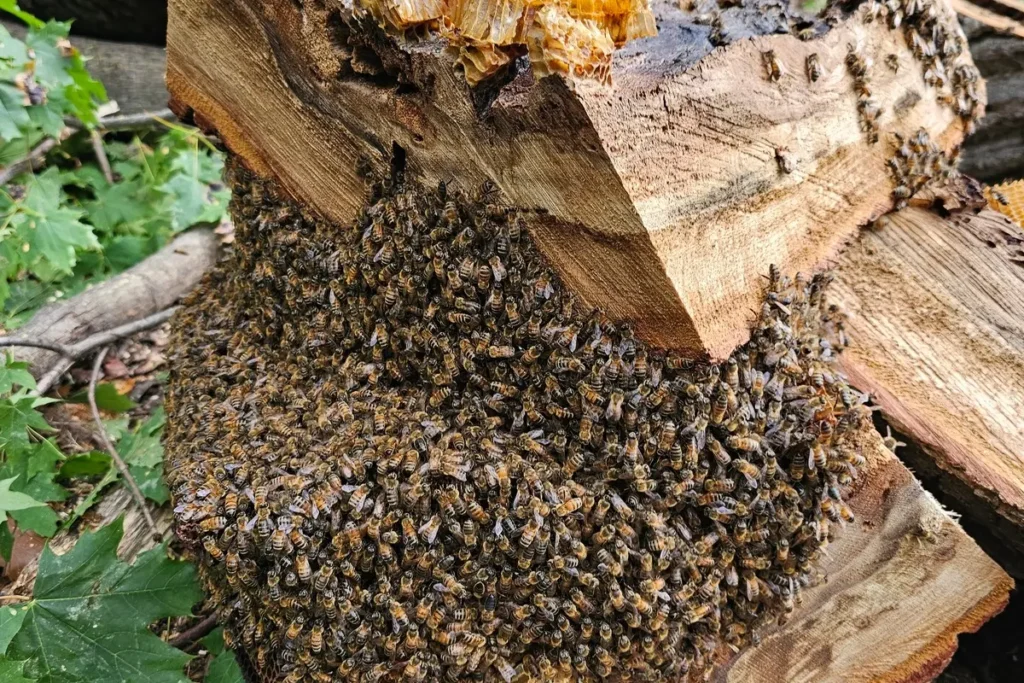
But the stakes were too high to give up on that piece of the rescue, so I carefully moved it away from the hive and set it down in front of the entrance.
Then I reassessed.
And that’s pretty much how the afternoon went.
Moving. Sweeping. Looking.
Trying one approach, discovering a new problem, and trying something else.
The bees were scattered across the remains of the tree, and every decision seemed to come with a new complication. I couldn’t just scoop them all up and hope for the best. I needed to get as many as possible into the hive, ideally with their queen, and give them a chance to regroup.
Meanwhile, the clock was ticking. It was past 3:30. I’d been working for more than an hour, and there were still quite a number of bees outside the hive. The hillside was getting darker, and the afternoon was sliding toward twilight.
I was running out of time.
A Total Hail Mary
And then I noticed something.
Some of the bees on that very heavy wedge had started moving off it and onto a live, dry tree trunk. It was a smooth silver birch tree with no rough bark for the bees – or the beetles – to hide in.
That little shift caught my attention.
Why were they leaving the log?
Bees don’t always make their intentions obvious, but their movements can tell you something. If they were abandoning that piece of wood, perhaps they were responding to something elsewhere. Perhaps they were beginning to regroup.
Or perhaps I was just desperately looking for a sign that things were going to work out.
Either way, I had an idea.
With daylight fading, I decided to pull a total Hail Mary.
I placed an empty bee frame perpendicular to the birch tree trunk, and used my brush to gently sweep this new cluster of bees onto it. Then I quickly moved it into the hive…hoping, and praying, that the queen was among them.
I couldn’t see her. I couldn’t be sure.
I could only hope.
And then I said my bee-prayers.
Because sometimes, after all the planning and hauling and worrying, that’s all you can do.
Hope.
Some bees were fanning, others were heading inside. Was the queen in their new home? I hoped so, but the signs weren’t clear. Only time would tell.
TO BE CONTINUED…
Note: If you find honey bees living somewhere unexpected, contact Backyard Bees before disturbing them. Maybe we can help.